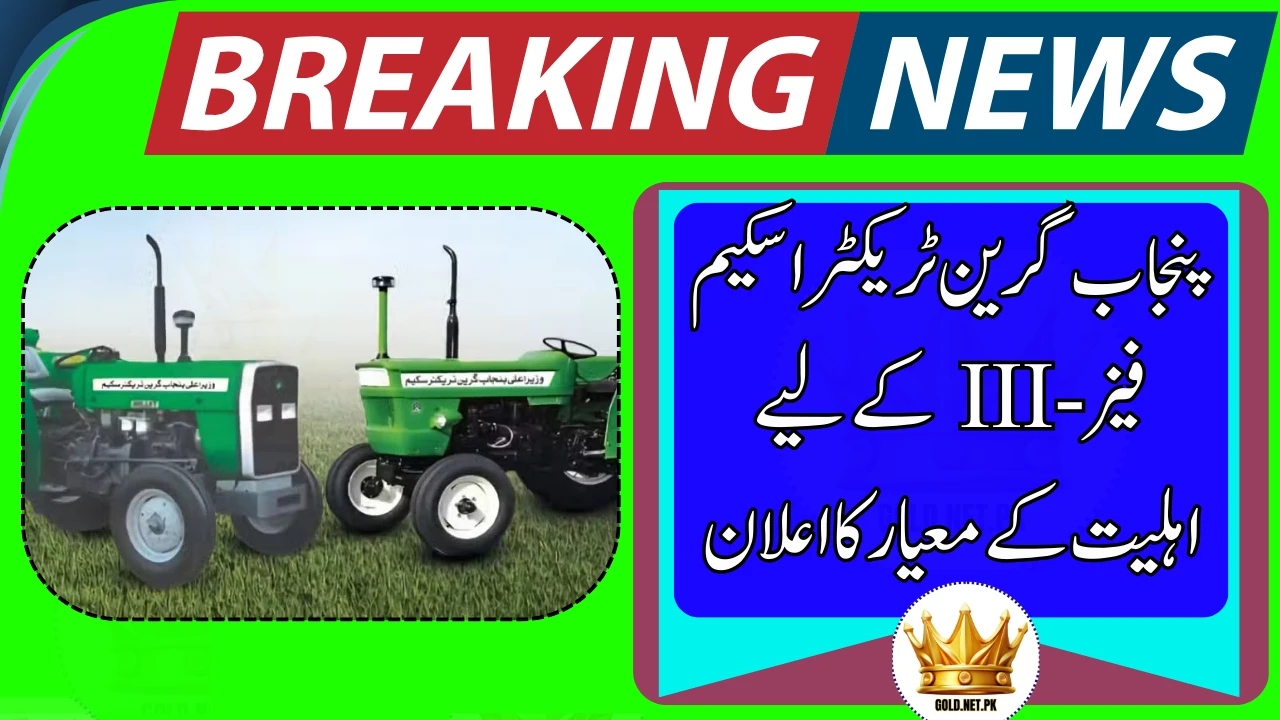
The Punjab government has officially launched Phase 3 of the Green Tractor Scheme (GTS) for 2026 under Chief Minister Maryam Nawaz Sharif, aiming to modernize agriculture, reduce farming costs, and support small and medium farmers across the province.
Under this phase, thousands of farmers will be able to purchase modern tractors at heavily subsidized prices, helping improve productivity and strengthen Punjab’s agricultural economy.
 Approved Tractor Models and Brands Under CM Punjab Green Tractor Scheme 2026
 Punjab Announces Eligibility Criteria for Green Tractor Scheme Phase-III
Objectives of Green Tractor Scheme Phase 3
The key goals of Phase 3 include:
-
Improving agricultural output through modern machinery
-
Reducing operational costs for farmers
-
Supporting farmers with smaller landholdings
-
Ensuring transparency through a digital e-balloting system
The scheme is part of Punjab’s broader strategy to promote mechanized and sustainable farming.
How the Scheme Benefits Farmers
The Green Tractor Scheme offers multiple long-term benefits:
-
Faster plowing, sowing, and harvesting
-
Reduced dependence on rented machinery
-
Lower labor and fuel costs
-
Access to high-horsepower tractors at affordable prices
-
Improved crop yields and farm efficiency
Approved Tractor Models and Brands Under CM Punjab Green Tractor Scheme 2026Punjab Announces Eligibility Criteria for Green Tractor Scheme Phase-III Punjab Green Tractor Scheme Enters Third Phase – Here’s How Farmers Can Apply
Subsidy Amount and Tractor Categories
| Tractor Category | Horsepower (HP) | Subsidy Amount | Manufacturer Type |
|---|---|---|---|
| Small Tractors | 50–65 HP | Up to Rs. 1,000,000 | Locally manufactured |
| Large Tractors | 75–125 HP | Rs. 1,000,000 | Local & imported |
-
Around 9,500 high-power tractors are available in this phase
-
The government aims to distribute 20,000 tractors across Punjab in 2026
Eligibility Criteria
Farmers must meet the following conditions:
-
Permanent resident of Punjab
-
Ownership of agricultural land
-
Minimum 7 acres required for high-power tractors
-
Valid CNIC
-
Active farmer status (Kisan Card preferred)
-
Not a bank or loan defaulter
-
Only one tractor per household
-
Previous beneficiaries of government tractor schemes are not eligible
Documents Required
Applicants should prepare:
-
CNIC (front and back)
-
Proof of land ownership (registry or official land record)
-
Passport-size photograph
-
Kisan Card (if available)
-
Bank account details
How to Apply Online for CM Green Tractor Scheme Phase 3
-
Register using CNIC and mobile number
-
Verify account through OTP
-
Fill in personal and land details
-
Select tractor category and horsepower
-
Upload required documents
-
Submit the application and save confirmation number
Selection Process
To ensure fairness, beneficiaries are selected through computerized e-balloting.
-
Balloting began on September 18, 2026
-
Selected farmers’ names are published on the official website
-
Lists are also displayed at Agriculture and Assistant Commissioner offices
After Selection: What Winners Must Do
-
Download official selection letter
-
Visit local Agriculture Office
-
Submit CNIC, land papers, and bank details
-
Complete purchase process
-
Collect subsidized tractor as per instructions
Key Points to Remember
-
Application is free of cost
-
Do not pay agents or middlemen
-
Apply only through official government channels
-
Late or incomplete applications are not accepted
Conclusion
The CM Green Tractor Scheme Phase 3 2026 is a major opportunity for Punjab farmers to upgrade their farming practices with modern machinery. With subsidies of up to Rs.1 million, a transparent selection process, and an easy online application system, the scheme aims to boost productivity, lower costs, and strengthen food security across the province.
Farmers meeting the eligibility criteria are encouraged to apply early and follow official updates for deadlines and results.