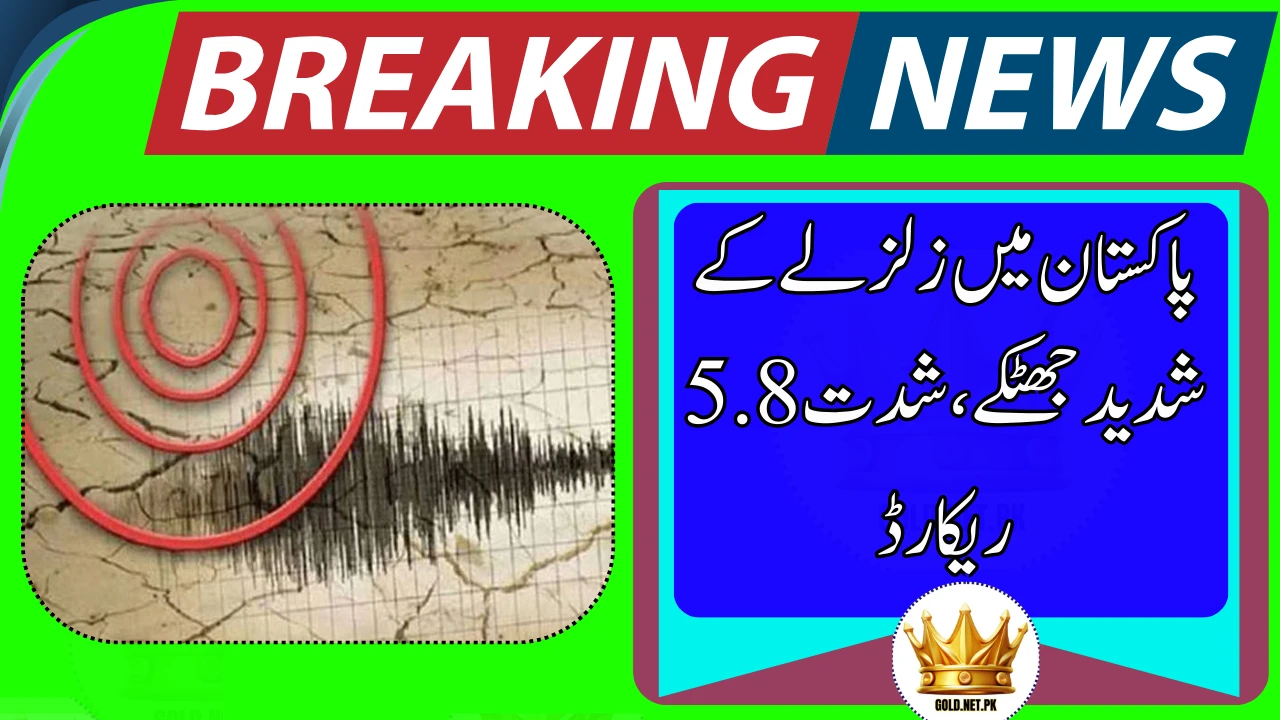
A moderate but widely felt earthquake struck several parts of Pakistan, triggering panic among residents across multiple regions. According to seismic monitoring centers, the earthquake measured 5.8 on the Richter scale.
The tremors were felt in Islamabad, Rawalpindi, Murree, Galiyat, Abbottabad, Gilgit, Skardu, Swat, Shangla, Buner, Neelum Valley, Muzaffarabad, and other areas of Azad Jammu and Kashmir.
 Demand Raised for Reduction in Packaged Milk Prices
 Marriage Speculation Trends Again After Social Media Interaction
Epicenter & Depth Details
Seismological data revealed that the earthquake originated near the border region of Tajikistan and Xinjiang, where tremors were recorded at a stronger intensity of 6.1 magnitude. The earthquake occurred at a depth of 159 kilometers, which helped reduce surface-level damage despite the wide geographical impact.
No Casualties Reported Yet
Authorities have confirmed that no loss of life or property damage has been reported so far. Emergency departments and local administrations remain on alert as the situation continues to be monitored.
Residents in affected cities rushed out of buildings as tremors lasted for several seconds, while social media quickly filled with reports from people experiencing shaking in homes, offices, and high-rise structures.
Demand Raised for Reduction in Packaged Milk PricesMarriage Speculation Trends Again After Social Media Interaction British Rapper Announces Conversion to Islam During Live Stream
Why Earthquakes Are Common in Pakistan
Experts explain that earthquakes occur due to the movement of tectonic plates beneath the Earth’s surface. Pakistan lies at the junction of three major plates — the Eurasian, Indian, and Arabian plates. When pressure builds underground, these plates shift, releasing energy in the form of seismic waves.
Pakistan is considered the fifth most earthquake-prone country in the world. Nearly two-thirds of the country lies on active fault lines, making cities from Karachi to Islamabad, Quetta to Peshawar, and Gilgit to Chitral vulnerable to seismic activity.
Seismologists warn that regions that experience strong earthquakes once may face future seismic events, particularly in sensitive zones like Kashmir and Gilgit-Baltistan.
Demand Raised for Reduction in Packaged Milk PricesMarriage Speculation Trends Again After Social Media InteractionBritish Rapper Announces Conversion to Islam During Live Stream China Builds Record Setting Highway Tunnel Through Mountain Terrain
 Chicken Prices Drop After Festival Buyers See Relief
 Delay in QR and Digital Payments Raises Concerns for Businesses